Tea? Herbal tea? Botanical infusion? Tisane? What’s the difference?
Why do we need so many names for what seems to be the same beverage?
Well, there actually are some important distinctions.
🍵 What Is “Tea”?
When we talk about true tea—black, green, white, oolong, or pu-erh—we’re talking about the leaves of one particular plant: Camellia sinensis.
The difference between these types of tea comes from how the leaves are harvested and processed. Depending on the type, processing can include withering, rolling, oxidation, heating, and drying.
True tea naturally contains caffeine, although the amount varies depending on the type of tea, how it is processed, and how it is prepared.
There are also flavored teas and tea blends, but if they’re made with Camellia sinensis, they’re still true tea.
🌿 What About Herbal Tea?
“Herbal tea” is the term most people use for beverages made by steeping plant materials other than Camellia sinensis.
That might include leaves, flowers, fruits, roots, bark, seeds, or spices.
Chamomile tea? Herbal tea.
Peppermint tea? Herbal tea.
Ginger tea? Herbal tea.
Technically, these are infusions rather than true teas.
☕ What Is a Tisane?
“Tisane” is essentially another name for an herbal infusion. The word comes to English through French and has been used for centuries to describe a beverage made by steeping plant material in water.
So if someone offers you a cup of tisane, you can generally expect an herbal tea—just with a slightly fancier name. 😉
💧 What Is an Infusion?
An infusion describes both a preparation method and the resulting liquid.
Simply put, plant material is steeped in a liquid so that the liquid extracts soluble compounds along with the plant’s flavor and aroma. Most commonly, that liquid is water. But plants can also be infused into other liquids such as vinegar, honey, or oil, depending on the desired preparation.
An oxymel, for example, combines an herbal preparation with vinegar and honey.
🌱 And Then There’s the Decoction
Some plant materials are tougher than others. Roots, bark, seeds, and certain dense plant parts may benefit from a different preparation method called a decoction. Instead of simply steeping the plant material, it is gently simmered in water for a longer period of time to help extract its soluble compounds.
So while an infusion and a decoction are both ways of extracting plant material into water, the preparation method is different.
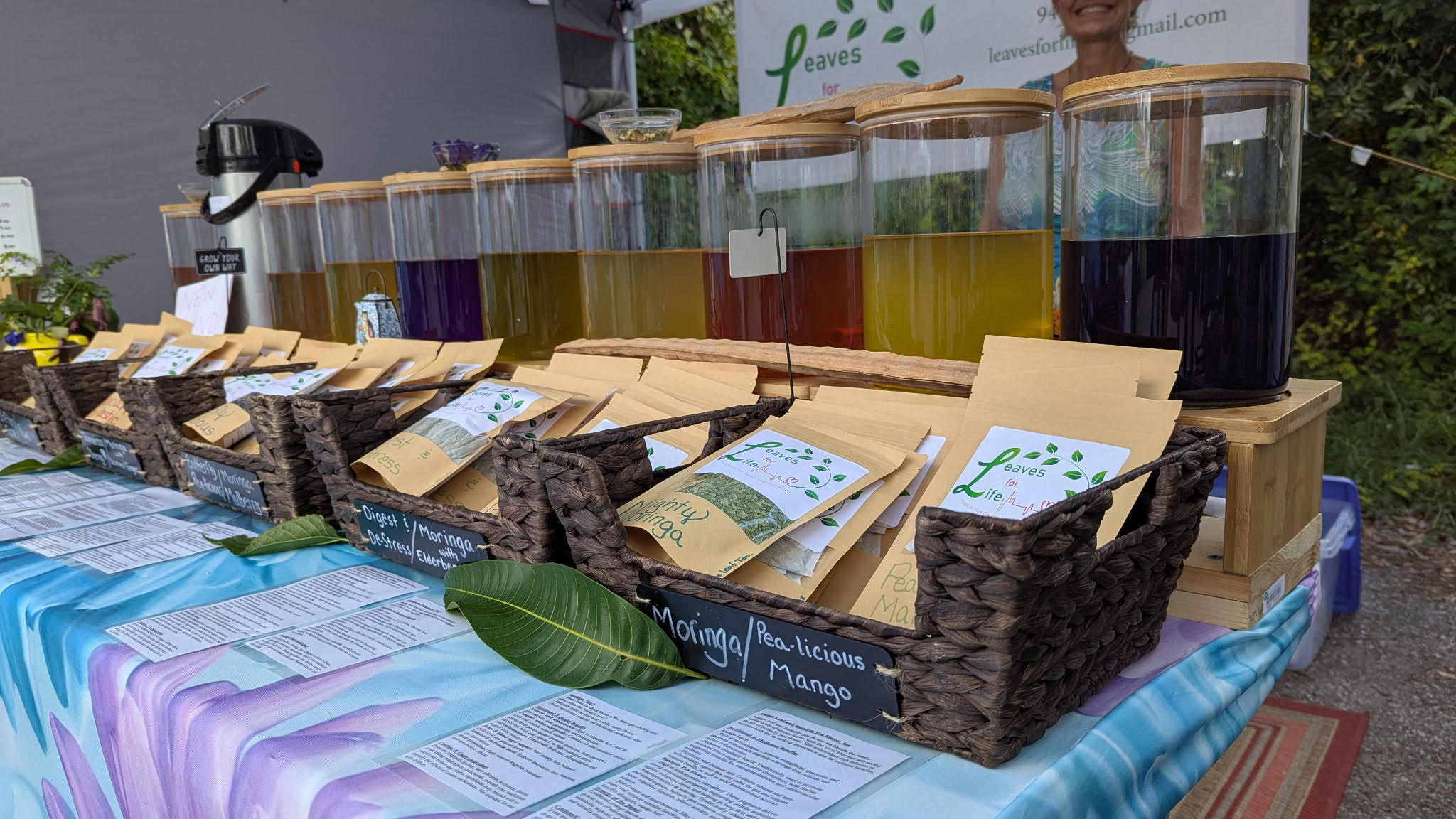
🌿 Why We Call Ours “Botanical Infusions”
Here at Leaves for Life, we use these terms somewhat interchangeably depending on who we’re talking to.
“Tea” is the easiest term for most people to understand, but it can also lead to the question, “Does it contain caffeine?”
“Herbal tea” is familiar to many people, but it often brings to mind traditional herbs such as chamomile and peppermint—plants that aren’t necessarily what you’ll find growing in our tropical Florida food forest.
And then there’s tisane. It’s accurate, but let’s be honest—barely anyone knows what it means. 😂
So we’ve chosen Botanical Infusions.
We like the term because it describes what we actually do. We work with botanicals—not just traditional herbs. Many of our ingredients are leaves from fruit and tropical trees, along with flowers, berries, roots, and rhizomes. And as our food/tea forest grows, the term gives us room to explore new plants and new preparations.
So, while “tea,” “herbal tea,” “tisane,” and “botanical infusion” are often used to describe very similar beverages, there are some real distinctions.
True tea comes from Camellia sinensis.
Infusions and tisanes use other plant materials.
Decoctions use simmering rather than simple steeping.
And here at Leaves for Life, you’ll find a little bit of all that plant diversity growing right here in our Florida food forest.
So tell us—what do you call it: tea, tisane, or herbal infusion?